
Winding Machine Tension Control: The Underrated “Quality Switch”
2026-06-21
Among all parameters on a winding machine, tension control is the most overlooked—and the most consequential. Too much tension stretches and deforms the wire. Too little leaves the winding loose and uneven. This article explains, from principle to practice, how tension control serves as the invisible switch for coil quality.
Why Tension Matters: Three Failure Cases
| Failure Symptom | Tension Problem | Consequence |
| Coil resistance 8% higher than design value | Excessive tension stretched copper wire, reducing cross-sectional area | Increased heat generation during motor operation, efficiency decline |
| Visible gaps between layers | Insufficient tension, wire not pulled tight | Coil volume expansion, unable to fit into bobbin during assembly |
| Frequent wire breakage during high-speed winding | Severe tension fluctuation, peaks exceeding wire tensile strength | Machine downtime for rethreading, reduced efficiency, higher scrap rate |
These three issues appear unrelated. Their root cause is the same: insufficient tension control precision.
How Tension Affects Coil Physical Properties
-
Impact on Conductor Resistance
When copper wire is stretched, length increases and cross-section decreases. Resistance rises according to the formula R = ρL/S. For precision inductor coils, resistance deviation directly affects Q factor and frequency characteristics.
Measured data: 0.1mm enameled wire, tension increased from 50g to 150g, resistance rises approximately 3–5%. For sensor coils requiring ±2% precision, this is unacceptable.
-
Impact on Inter-Layer Compactness
Insufficient tension causes the wire to “float” during traverse, creating gaps between layers. Consequences:
Coil outer diameter expands, interfering with bobbin fit
Inter-layer capacitance becomes inconsistent, high-frequency characteristics drift
Insulation paper insertion difficult, withstand voltage test failures
-
Impact on Insulation Integrity
Enameled wire insulation film thickness is only a few microns. Excessive tension increases friction against wire guides and pulleys, generating micro-cracks. During subsequent varnishing or high-temperature operation, cracks propagate and cause turn-to-turn short circuits.
Three Technical Approaches to Tension Control
| Technical Solution | Principle | Precision | Application Scenario | Cost |
| Mechanical tensioner (spring/weight) | Physical gravity or spring force provides damping | ±15% | Heavy wire, low speed, low precision requirements | Low |
| Magnetic powder brake + open-loop control | Magnetic particle chain transmits torque, current controls braking force | ±8% | Medium precision, general winding | Medium |
| Servo tension + closed-loop sensor | Tension sensor real-time feedback, servo motor dynamic adjustment | ±2% | Fine wire, high speed, precision coils | High |
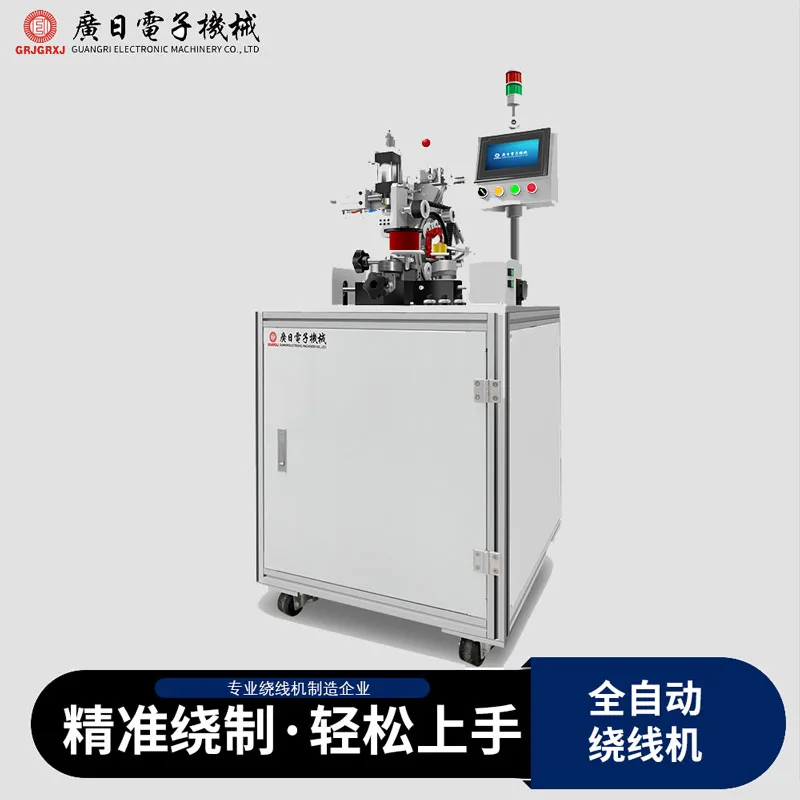
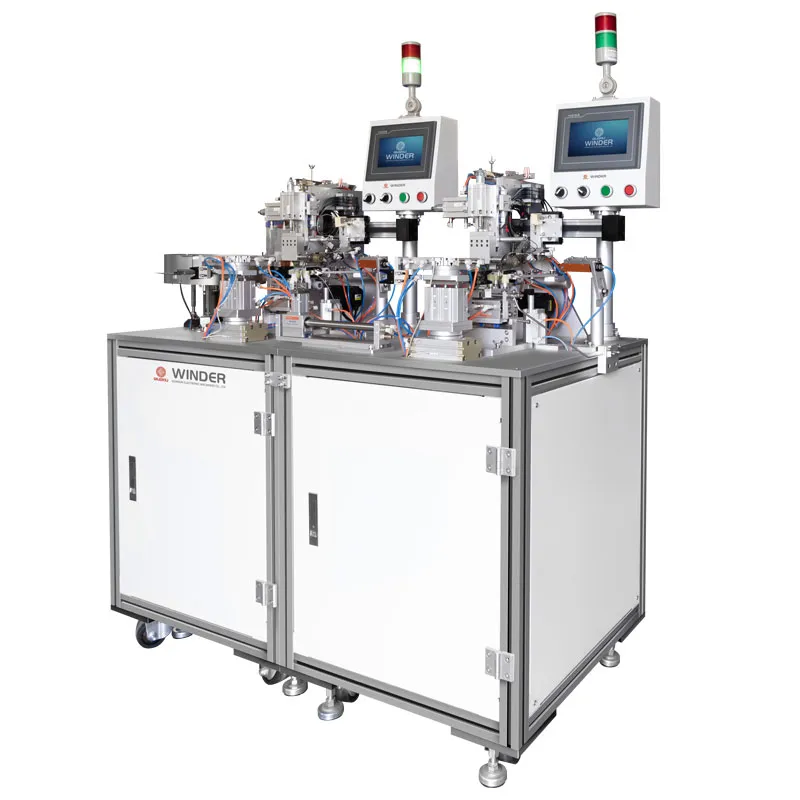
Guangri Electronics Machinery’s JGJ6204 adopts magnetic powder brake + tension sensor closed-loop, balancing precision and cost. For higher requirements (e.g., wire below 0.03mm), upgrade to full servo tension system is available.
Tuning Tension: Not a Single Value, But a Range
Operators often ask: “What tension should I set?”—the question itself is flawed. The correct question is: “At this speed, with this wire diameter and bobbin, what tension range produces optimal coil quality?”
Tuning Steps
- Table lookup for initial value: Based on wire diameter and material, refer to manufacturer recommended tension range (e.g., 30–80g for 0.1mm copper wire)
- Low-speed trial winding: Run at 30% normal speed, wind 5 layers, visually inspect winding tightness
- Gradual speed increase: At each speed increment, observe tension fluctuation amplitude and coil appearance
- Verify critical indicators: Measure resistance, inter-layer height, insulation withstand voltage, confirm compliance
Key insight: Tension is not constant. During start, finish, and layer transitions, wire inertia causes tension spikes. The JGJ6204 controller’s built-in PID dynamic compensation algorithm automatically adjusts at these nodes, reducing manual intervention.
The Overlooked Detail: Tension-Speed Coupling
Many operators adjust tension and speed independently, ignoring their coupling:
| Speed Change | Tension Change | Cause |
| Acceleration phase | Instantaneous tension drop | Wire inertia lags, supply spool not releasing fast enough |
| Steady speed phase | Tension stabilizes | System reaches dynamic equilibrium |
| Deceleration phase | Instantaneous tension rise | Wire inertia surges forward, supply spool not braking fast enough |
| Emergency stop | Tension peak may break wire | No buffer, wire absorbs impact load |
The JGJ6204’s ramp-up/ramp-down function addresses this exact problem: by extending acceleration and deceleration time, the tension system has sufficient response window to avoid spikes.
Conclusion
Tension control is the “hidden line” in winding process—invisible, yet determining whether a coil passes every test. Guangri Electronics Machinery includes tension closed-loop as standard configuration, not optional, across the JGJ6204 and entire product line. Because we believe: precision is not a premium, it is the baseline.
For technical details on tension systems or higher-precision winding solutions, contact Guangri Electronics Machinery technical team.